
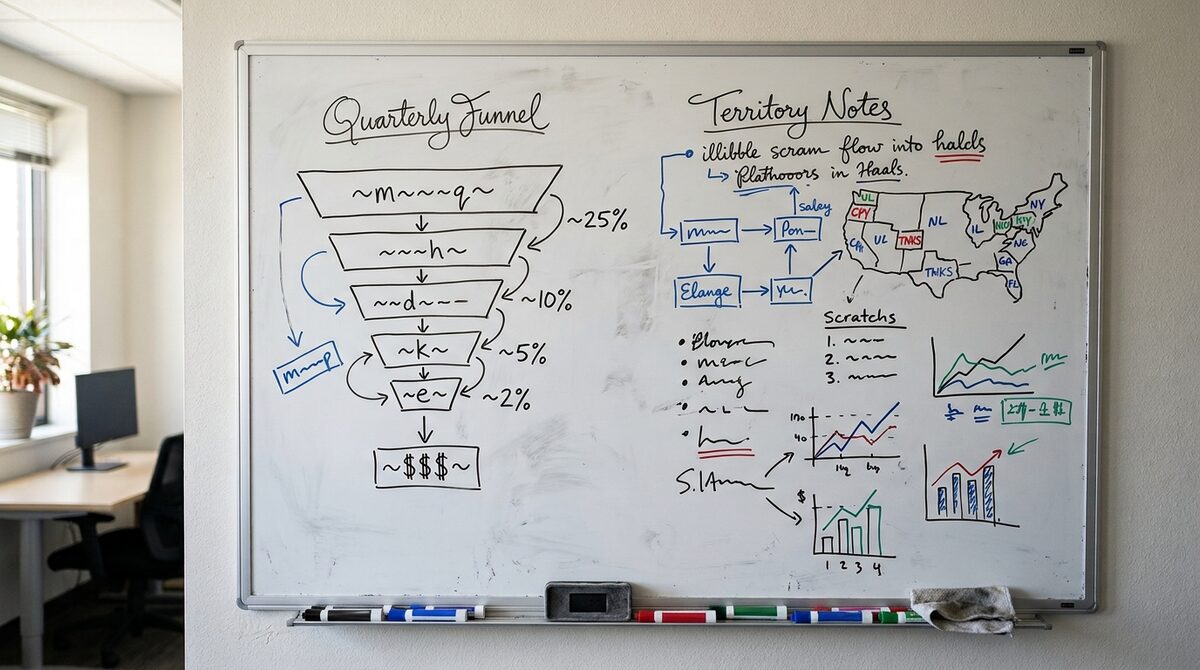
Open post Sales team reviewing the importance of a structured sales process on a whiteboard

The Importance of a Sales Process: 7 Stages Every B2B Team Needs

The Importance of a Sales Process: 7 Stages Every B2B Team Needs

If your sales team is working hard but results are inconsistent, the problem usually isn’t effort – it’s the absence of a defined path to follow. At Scorecard Sales, we’ve worked with dozens of B2B companies across south-central Pennsylvania, and the pattern is almost always the same: teams without a structured sales process rely on individual instinct rather than a repeatable system. That’s a fragile way to build revenue.

A structured sales process changes that. It gives every rep on your team a clear roadmap – from the first conversation with a prospect all the way to closing the deal and following up. The result? More consistency, better forecasting, and a measurable lift in performance.

According to research, companies with a structured sales process outperform those that don’t by as much as 18% in revenue. That’s not a minor edge – that’s the difference between hitting quota and missing it by a wide margin. nutshell

What Is a Sales Process?

A sales process is a defined set of repeatable steps your sales team follows to move a prospect from initial contact to a closed deal. It’s the structured path that outlines the specific actions needed to close deals and cultivate client relationships throughout the sales cycle. nutshell

It’s worth separating this from a sales methodology. Your sales process is the what – the stages and sequence. Your methodology is the how – the philosophy and approach behind each stage. Both matter, but without a process, even the best methodology falls apart in execution.

You can think of it like a recipe. As we’ve explored in our post on why salespeople are like cooks with recipes, the best performers don’t improvise every meal – they follow a proven formula and then refine it over time.

Why Is a Sales Process Important?

The importance of a sales process goes beyond just keeping reps organized. It affects nearly every performance metric your business cares about.

1. Consistency Across the Team
When every rep follows the same process, your results become predictable. One strong rep closing deals through personal charm isn’t scalable. A documented process is.

2. Accurate Sales Forecasting
A well-defined sales process creates consistency, improves forecasting accuracy, and helps reps close deals faster by aligning with how buyers make decisions. When your stages are clear, your pipeline data becomes reliable – which means your revenue projections actually hold up. nutshell

3. Faster Onboarding
A clearly defined process simplifies the training and onboarding of new sales team members. It provides a framework that enables new hires to quickly understand your sales approach and start contributing to the organization’s success. nutshell

4. Identifying Bottlenecks
When deals stall or fall through, a defined process tells you exactly where it happened. Without it, you’re guessing. With it, you can fix the specific stage that’s leaking revenue – which is exactly what we cover in The Leaky Sales Pipeline: Why You’re Losing Deals and How to Stop It.

5. Better Buyer Experience
A structured approach means your prospects are guided – not pressured. A standardized sales process ensures that sellers don’t advance the sale until the buyer is ready to move forward. That builds trust, and trust closes deals. nutshell

Infographic showing the 7 key stages of a B2B sales process from prospecting to follow-up
The 7 stages of a sales process – each step builds on the last. Skip one and deals start falling through the cracks.

The 7 Key Stages of a Sales Process

Whether you’re in manufacturing, professional services, or any other B2B industry, these seven stages form the foundation of an effective sales process.

Stage 1: Prospecting and Lead Generation

Prospecting is where it all starts. This means identifying companies and contacts who match your ideal customer profile. Good prospecting is targeted, not scattered – you’re looking for the right fit, not just volume.

For practical guidance on this, see our guide on how to prospect for customers.

Stage 2: Lead Qualification

Not every lead deserves equal time. Qualification means determining whether a prospect has the need, budget, authority, and urgency to buy. Spending time on unqualified leads is one of the most common causes of missed quota – a problem we dig into in B2B Sales Quota Crisis: Process Improvement Tools.

Stage 3: Discovery and Needs Analysis

This is where most salespeople underinvest. Discovery isn’t just asking questions – it’s listening to understand the prospect’s real pain points. The goal is to uncover what they need, not to pitch what you sell. Our post on The 3 Critical Discovery Questions is essential reading for this stage.

Stage 4: Presenting Your Solution

Once you understand the need, you present a tailored solution. This is not a product demo for the sake of it – it’s a targeted response to what you learned in discovery. If you’re still emailing proposals and hoping for the best, read Stop Sending and Praying: Why Your Proposal Needs a Live Presentation.

Stage 5: Handling Objections

Every serious buyer has objections. The best reps treat objections as requests for more information – not as rejections. Price is the most common one, and we’ve broken down how to handle it in Price: The Deadliest Sales Objection.

Stage 6: Closing the Deal

Closing is the natural result of doing stages 1-5 well. If you’ve qualified correctly, discovered the real need, and handled objections professionally, closing becomes a confirmation – not a confrontation. For teams struggling here, our sales coaching services address the specific behaviors that stall deals at this stage.

Stage 7: Follow-Up and Relationship Building

The sale doesn’t end at the signature. Follow-up and relationship management drive referrals, renewals, and upsells. Leveraging technology for training and development guarantees your team stays ahead – and that includes using CRM systems to stay systematically connected to your existing customers. For tactics here, see Cross-Selling and Upselling Made Simple. Small Business Trends

What Happens Without a Defined Sales Process?

It’s worth being direct about this. Without a process, deals are simply won or lost, and it’s hard to know which specific actions are working or failing. hubspot

That means:

  • You can’t coach to a standard that doesn’t exist
  • You can’t scale what isn’t documented
  • You can’t forecast what you can’t track

This is precisely why 86% of sales teams operate without documented processes – and why so many B2B companies plateau despite hiring talented reps.

How to Build and Improve Your Sales Process

Building a sales process starts with documenting what your best reps already do – then standardizing it across the team. From there, you measure performance at each stage, identify where deals stall, and make targeted improvements.

If you want a proven framework to do this, our Integrative Sales Improvement Process is specifically designed for B2B companies in south-central Pennsylvania who want a structured, measurable approach to sales growth.

For a complete walkthrough, our Ultimate Guide to Creating a Sales Process covers every element in depth.

External resources worth reviewing:

The Role of Sales Coaching in Your Process

A defined process only works if your team is trained to execute it. That’s where sales coaching becomes the multiplier. Data shows that dedicated coaching delivers 28% higher win rates – and the difference between a team that has a process and a team that uses it well comes down to how they’re coached.

Our sales training courses are built around your specific sales process – not generic selling theory.

Sales coach working one-on-one with a B2B sales rep to improve sales process execution
A defined process only delivers results when your team is coached to execute it consistently – stage by stage.

FAQs: Importance of a Sales Process

Why is a sales process important for B2B companies?

B2B sales cycles are longer and involve multiple decision-makers. A defined process ensures your team stays consistent at every stage, reduces lost deals due to poor follow-through, and gives managers the visibility they need to coach effectively. Without it, every rep becomes an island – and results become unpredictable.

What are the 7 steps of a sales process?

The seven stages are: Prospecting, Lead Qualification, Discovery and Needs Analysis, Presenting the Solution, Handling Objections, Closing the Deal, and Post-Sale Follow-Up. Each stage builds on the previous one – skipping stages is one of the most common reasons deals fall apart late.

Does a formal sales process actually increase revenue?

Yes – companies with a structured sales process significantly outperform those that don’t, with revenue improvements of up to 18%. The lift comes from consistency, reduced deal slippage, and the ability to identify and fix weak stages in your pipeline. nutshell

Can a sales process be customized for different industries?

Absolutely. The core stages stay largely the same, but the language, qualification criteria, and objection types differ by industry. A manufacturing company in York, PA has different buyer dynamics than a SaaS firm – and your process should reflect that. Our sales process improvement tools are built to adapt to your specific market.

What is the difference between a sales process and a sales methodology?

Your sales process is the what – the defined stages your team moves through with every prospect. Your sales methodology is the how – the philosophy guiding behavior at each stage (e.g., Sandler, Challenger, SPIN). The process provides structure; the methodology provides approach. You need both, but the process comes first.

How do I know if my sales process is working?

Track your conversion rates at each stage. If deals are dropping off consistently at the same point, that stage needs attention. Win rate, average deal length, and quota attainment are the three numbers that tell you whether your process is driving results – or just creating documentation. See our 5 tips for enhancing sales forecasting accuracy and how to measure this effectively.

Open post B2B sales process pipeline diagram showing stages from lead generation to closed deal

Streamlining Your Sales Process: Proven Strategies for Increasing Revenue

Streamlining your sales process is not a one-time fix – it’s the ongoing discipline that separates teams that consistently hit quota from those that scramble every quarter. At Scorecard Sales, we’ve worked with B2B companies across South Central Pennsylvania long enough to see the same pattern repeat itself: the teams that grow revenue year over year are not necessarily the ones with the most talented reps – they’re the ones with the most reliable process. This guide walks you through proven strategies for increasing revenue by tightening every stage of your sales cycle, from first contact through close and beyond.

Key Takeaways

  • A streamlined sales process reduces wasted effort and increases revenue predictability.
  • Documenting your process creates a repeatable playbook anyone on the team can follow.w
  • Lead quality consistently outperforms lead volume when time and resources are limited
  • CRM and automation remove friction – but only when your team actually uses them
  • Ongoing coaching is non-negotiable for turning process knowledge into consistent execution.ion

Why Streamlining Your Sales Process Actually Moves the Revenue Needle

Most sales problems don’t start with the pitch. They start earlier – with unclear handoffs between stages, inconsistent qualification, and steps that live in someone’s head but nowhere else. When reps work from memory instead of a shared, documented process, results depend on the individual rather than the system. That’s a fragile position for any business.

A well-defined sales process does three specific things your team needs: it creates consistency across reps, it makes coaching faster and more targeted, and it surfaces exactly where in the funnel deals are dying. You cannot fix a leak you cannot locate. According to HubSpot’s State of Sales research, companies with a formal, documented sales process consistently close at higher rates than those operating informally.

The common failure points we see most often: undefined pipeline stages that mean different things to different reps, no clear criteria for advancing a deal, and zero post-sale process to capture referrals and expansion revenue. These aren’t talent problems. They’re process problems.

Defining Your Sales Process – Start With the End Result

Before mapping your stages, start with the outcome. What does a successfully closed deal look like? What does the customer’s journey feel like from their side? Work backward from the result, not forward from the first call.

Here’s a practical starting framework that works across B2B sales teams:

  1. Define the desired result – not just “closed deal” but the customer’s first measurable win
  2. Involve your top performers – they’re already doing something right; document it before it walks out the door
  3. Build entry and exit criteria for each stage – what has to be true for a deal to move forward?
  4. Map the buyer’s journey alongside your sales stages – your process should match how they buy, not just how you like to sell
  5. Implement, test, and adjust – the first version is never the final version

For a comprehensive walkthrough of building a process from the ground up, The Ultimate Guide to Creating a Sales Process covers each stage with the specificity most guides skip.

Lead Generation Techniques That Actually Fill the Pipeline

A streamlined process breaks down fast when the top of the funnel is packed with the wrong prospects. Lead generation is not just about volume – it’s about attracting people who are actually positioned to buy from you in a reasonable timeframe.

B2B salesperson using social media for lead generation and sales prospecting
Done right, social media outreach puts your team in front of decision-makers before they’re actively shopping

Social Media Outreach

LinkedIn remains the most reliable B2B prospecting channel for companies selling to business buyers. Consistent, value-first content gets you visible to decision-makers without cold outreach fatigue. For a tactical breakdown of how to actually convert social activity into pipeline, Leveraging Social Media for Sales Prospecting and Lead Generation is worth bookmarking.

Email Marketing

Nurture sequences built around specific buyer pain points outperform generic newsletters every single time. The email that feels like a direct reply to a problem the prospect is already wrestling with gets opened. The broadcast that shows up in the same format every week gets ignored.

Referral Programs

A satisfied customer is your cheapest and most credible lead source – and most companies leave this completely to chance. Build the referral ask into your post-sale process instead of hoping it happens organically. When you systematize it, it shows up consistently.

Qualifying Prospects – The Step Most Teams Rush Through

Most deal losses are qualification failures dressed up as closing problems. Spending one hour disqualifying a bad-fit lead saves three weeks of proposal writing, follow-up, and negotiation that goes nowhere and costs margin you cannot get back.

An effective qualification framework answers four questions before significant time is invested: Does this prospect have the specific problem you solve? Do they have the budget authority? Are you speaking with the actual decision-maker or an influencer? Is the timeline real and driven by something external, or is it a placeholder?

Setting clear goalposts in your sales process only works if you know what you’re qualifying against. According to Salesforce’s B2B sales research, teams using a formal qualification framework see substantially higher win rates than those relying on intuition alone. Build your qualification criteria before the conversation, not after.

Effective Sales Presentations – Tailored, Not Templated

A polished deck sent to everyone is worse than a rough, honest conversation built around this specific customer’s situation. The best reps we work with invest as much time preparing for a presentation as they do delivering it.

Three principles that hold up regardless of industry or deal size:

  • Tailor the opening to their business specifically – reference something real about their situation, not a general capability you offer everyone
  • Lead with outcomes, not features – your prospect doesn’t care how your solution works; they care what changes in their business after they buy it
  • Address the likely objection before they raise it – this signals preparation, earns credibility, and removes the adversarial dynamic from the conversation. ation

The psychology behind why this matters goes deeper than most people expect. The Psychology of the Sale breaks down the decision-making dynamics at work in every sales conversation worth having.

Negotiation Tactics That Protect Margin Without Losing the Deal

The goal of negotiation is not to win – it’s to find the arrangement where the customer succeeds, and you get paid fairly for delivering that. Reps who treat negotiation as a battle end up with either a lost deal or a resentful customer who cancels at the first renewal opportunity.

What actually works in practice:

  • Ask questions before making concessions – the stated objection is often not the real one
  • Use data to anchor value, not just price – when a prospect understands what the alternative costs them, the conversation shifts
  • Find trade-offs that cost you little but matter to them – timeline flexibility, payment terms, scope sequencing.

For a direct treatment of the objection that derails more B2B deals than any other, Price: The Deadliest Sales Objection is worth reading before your next negotiation.

Leveraging Technology to Remove Friction From Your Process

CRM dashboard showing B2B sales pipeline metrics and deal tracking for sales process optimization
The right CRM gives your entire team visibility into the pipeline – not just your top reps

Technology in sales has exactly one job: remove administrative weight so reps spend more time actually selling. A CRM with features nobody uses is not a sales tool – it’s an expensive reporting obligation.

The core stack that works for most B2B teams without overcomplicating things:

  • CRM – pipeline visibility, activity tracking, and deal history in one place
  • Email automation – nurture sequences and follow-up reminders that run without manual effort
  • Analytics – specific visibility into where deals stall and where your best leads originate

Scorecard Sales has developed web-based Sales Process Improvement Tools built specifically to help teams track activity in real time and identify execution gaps before they become revenue gaps. Technology should surface problems faster – not bury them under dashboards nobody opens.

Training and Development – Your Highest-ROI Investment in Sales

Hiring a capable rep and not developing them is expensive. Hiring a struggling rep and investing in targeted development is exactly how most high-performing sales teams were actually built.

Effective training is specific, not generic. It targets the exact skills and situations where individual reps are losing deals – not a one-size curriculum that covers everything and changes nothing. If your top performers close at 40% and your team average is 22%, the gap is not effort. It is skill and process. Sales Coaching closes that gap faster than any other investment available to a sales leader.

Sales Training Courses provide the structured framework for skill development at the team level. HubSpot’s research on sales training ROI shows companies investing in ongoing development see meaningfully higher net sales per employee than those treating training as a one-time event.

Post-Sale Strategies – Where Most Revenue Is Left on the Table

The sales process does not end at “yes.” The customer’s first 90 days determine whether they renew, refer, and expand – or quietly shop for alternatives while maintaining the appearance of loyalty.

Build three things into your post-sale process:

  1. Structured onboarding check-ins – not “let us know if you need anything” but specific touchpoints with specific agendas
  2. Feedback loops – a short conversation at 60 days surfaces more actionable information than any survey ever sent
  3. Upsell and cross-sell triggers – tied to usage patterns and actual results, not quota pressure

For the practical mechanics of expanding revenue from customers you already have, Cross-Selling and Upselling Made Simple is a solid starting point.

Data-Driven Sales Optimization – Measure What Actually Predicts Revenue

Gut feel has a role. Data has a bigger one. Teams that consistently hit quota are not guessing – they’re tracking the specific metrics that actually predict revenue before the quarter ends.

The four numbers worth watching closely:

  • Lead-to-opportunity conversion rate – are your qualification conversations improving?
  • Average deal size – are your reps selling the full solution or leaving scope on the table?
  • Sales cycle length by stage – where exactly are deals spending too much time?
  • Win rate by rep – where is the coaching leverage the highest?

For building reliable forecasts from these numbers, 5 Tips for Enhancing Sales Forecasting Accuracy breaks down the process in a way that is actually actionable, not just theoretical.

Building a Customer-Centric Sales Culture That Sustains Revenue Growth

Process without culture eventually breaks down. The teams that sustain growth over multiple years are the ones where the customer’s success is genuinely central – not just in the pitch, but in every decision after the deal closes.

Practically, this means:

  • Sharing customer wins publicly inside the team as behavioral reinforcement, not just celebration
  • Making it easy for reps to escalate issues before they become churns
  • Personalizing follow-up based on each customer’s specific results, not a generic sequence

The Integrative Sales Improvement Process is built around this principle – that sustainable sales performance comes from building a system that works consistently, not from depending on heroic individual effort quarter after quarter.

Sales coaching framework diagram showing sales process, coaching scorecard, coaching model, cadence, and review loop
The parts of a sales coaching framework that hold up past the first busy quarter.

Frequently Asked Questions

What does it mean to streamline your sales process?

Streamlining your sales process means identifying, documenting, and improving each stage of your sales cycle so your team moves prospects from first contact to closed deal with less wasted time and fewer dropped opportunities. It involves removing unnecessary steps, clarifying criteria for advancing deals, and building repeatable habits your entire team can execute consistently – not just your top two reps.

How do I know if my current sales process needs to be streamlined?

The clearest signs are: long sales cycles with no explanation for the delay, wide performance gaps between your top and average reps, frequent deal losses to “no decision,” proposals being emailed without a live presentation, and no documented process for what happens after the deal closes. If your best rep’s approach exists only in their head, your process needs work now.

What is the most important step in a sales process?

Qualification. The majority of deal failures trace back to investing significant time in a prospect who was never going to buy – wrong fit, no real budget, wrong contact, no genuine urgency. A disciplined qualification stage saves more time and revenue than any other single improvement you can make elsewhere in the cycle.

How can CRM and technology help streamline a sales process?

A CRM provides visibility into every deal’s current stage, history, and next step. Automation handles follow-up sequences so nothing falls through the cracks due to rep oversight. Analytics surface the specific stages creating bottlenecks in your pipeline. The key is adoption – a CRM three people use inconsistently helps no one. Start simple, build the habit, then add layers.

How long does it take to see results from sales process improvement?

Most teams see early indicators – faster deal velocity, sharper lead quality, more accurate forecasts – within 60 to 90 days of implementing a documented process with accountability around it. Meaningful revenue impact typically shows up within one to two quarters, depending on your average sales cycle length.

What role does sales coaching play in process improvement?

Coaching is the bridge between knowing the process and executing it consistently under pressure. The process tells reps what to do – coaching builds the judgment to handle the situations where the process gets complicated. Without ongoing coaching, even a well-designed process degrades as reps revert to old habits over time.

What is the difference between a sales process and a sales strategy?

A sales strategy defines who you’re targeting, what you’re offering, and why they should choose you over alternatives. A sales process defines how your team executes that strategy on every call, in every deal, every day. Strategy without process is intention. Process without strategy is motion without direction. You need both working together.

Conclusion:

Streamlining your sales process is not about adding more steps to an already busy team – it’s about ensuring every step you have serves a real purpose and moves the deal forward in a way the customer can follow and trust. Teams that build documented, coachable, data-informed processes consistently outperform those that rely on individual talent alone – and they do it more predictably, quarter after quarter.

If you’re ready to audit your current process and close the gaps that are costing you revenue, Scorecard Sales works with B2B teams across Pennsylvania to build the systems that turn consistent effort into consistent results.

Goal Posts: The Most Important Thing In A Sales Process

Imagine yourself playing a game of soccer. You’re on the field and you can kick the ball in any direction you want to. No one is blocking you and you have to score a point, but there’s only one problem: no goal post. Nowhere on the field do you see anything that resembles goal posts, all eyes are on you and you have to do something with the ball so, what do you do? Just kick and hope? Stand and wait?

Whatever you choose you’re going to look kind of silly trying to score a point, and that’s what it looks like when salespeople engage customers without knowing what the next sales process steps should be. You’re just running around on the field kicking a ball not knowing where to go. Wouldn’t it be great in sports if you could just put the goal post anywhere you wanted to so you could score points constantly? Well, that’s exactly what you can and should do in sales.


Every step of every sales process should have a predetermined optimal outcome. In other words, once I have this conversation, demonstration, or proposal, this is what I want to have happen; the commitment for the next step. At Scorecard Sales, we teach that showing those goal posts right away is strategically important. This transparency is a core part of an integrative sales improvement process.

Once the customer can clearly see the goal post with you, they can help you get the ball to the goal even faster. Here are helpful tips for establishing sales process steps and goal posts to keep your sale moving forward:

5 Reasons to Invest in Sales Training Right Now in York PA

Make it simple – Complicated goal posts are hard to reach. If you are finding it difficult to simplify, you likely need to break the process into smaller steps. You can see examples of this on our blogs page.


Write it out – This is the easiest way to see your goal post. To learn more about us and how we visualize success, visit our company profile.


Make the goal post visible to everyone -What you want should never be a secret. Share your goal at the beginning and come back to it at the end. This level of clarity is a major focus in our B2B sales training.


Take the shot – Never waste a kick in sales when you are heading for the goal. If you have the right goal post, the customer will help you get the ball over that line and you can both high five each other when you do.  

Using sales performance software (our web tools) can help you track these sales process steps and measure how often your team hits the goal post. If you need a more structured approach, our sales methodology training and sales consulting services provide the framework you need.

Ready to stop “running around the field” and start scoring? Request a quote for a customized training session today. The customer will be ready for the shot—are you?