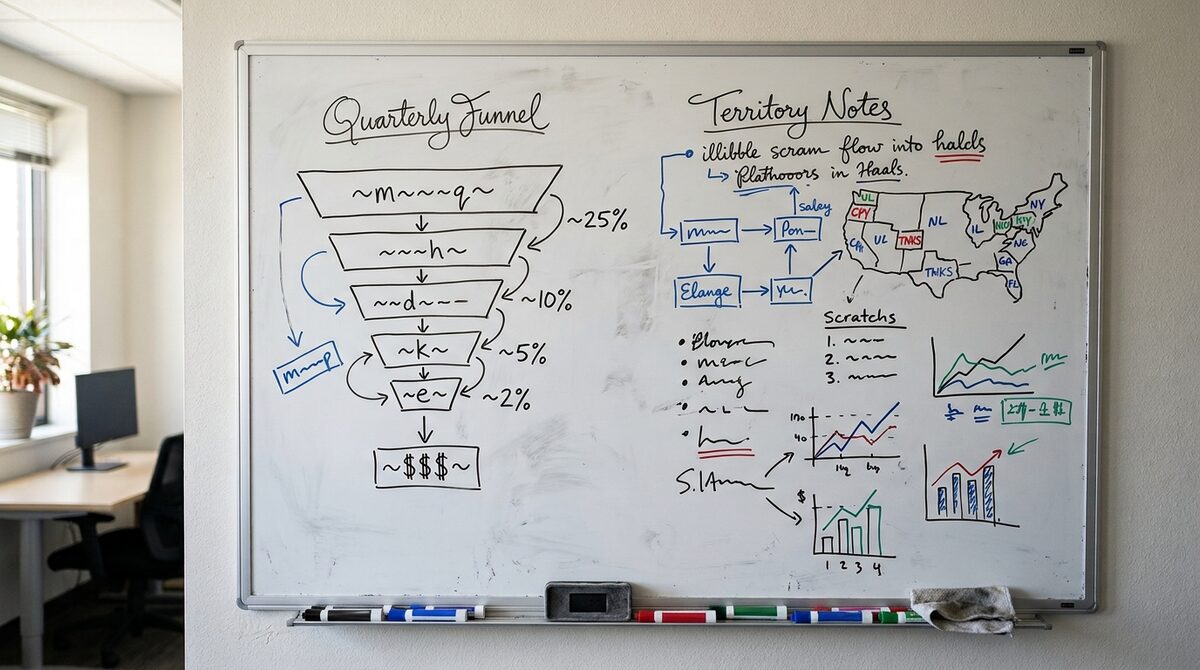
Open post B2B sales process pipeline diagram showing stages from lead generation to closed deal

Q3 2026 B2B Sales Outlook: What South-Central PA Construction, Manufacturing & Insurance Teams Should Expect This Quarter

Scorecard Sales – B2B Sales Training & Coaching for York, PA

The third quarter of 2026 is shaping up to give B2B sales teams across York, Lancaster, and the surrounding counties a rare kind of tension: demand looks set to keep climbing just as most sales organizations are least equipped to capture it. Here is what the quarter ahead is likely to bring – and how to be ready for it.

Regional manufacturing, the backbone of the South-Central Pennsylvania economy and a core customer base for the area’s construction and commercial insurance firms, is entering the quarter on its strongest footing in years. The Federal Reserve Bank of Philadelphia’s Manufacturing Business Outlook Survey, which tracks firms across eastern and central Pennsylvania, pushed its general activity index to its highest reading since late 2021 just as Q3 began, with new orders and shipments both rising. National readings point the same way: factory activity has expanded for six consecutive months, the longest run since 2022, and manufacturers have begun rebuilding lean inventories in anticipation of stronger demand. Together, those signals suggest the quarter ahead should bring more buying activity, not less.

That should make Q3 unambiguously good news. The complication sits on the selling side – and it is why we expect a gap to open between the market and actual results. Across the B2B economy, quota attainment has slid to historic lows, and deals have been taking longer to close than they did a few years ago. Rising demand does not convert into signed contracts on its own, especially now that buyers have changed how they buy. The teams that finish this quarter ahead will be the ones that turn a favorable market into pipeline, rather than assuming the market will do the work for them. That is the heart of why we wrote about the widening gap between the industrial rebound and the quota shortfall.

A quarter that will reward disciplined selling

South-Central Pennsylvania’s mix of precision manufacturers, food processors, contractors, and independent insurance agencies gives the region a broad, resilient base – but also a crowded competitive field. As orders pick up through Q3, expect larger Mid-Atlantic rivals to push harder into the same accounts. Construction firms bidding commercial projects, manufacturers quoting new work, and insurance producers renewing and expanding books will all feel the same pressure: more opportunities on the table, and more competitors reaching for them.

The differentiator is rarely price. It is how consistently a sales team qualifies opportunities, reaches the right decision-makers, and guides buyers to a confident “yes.” That is a skills-and-process problem, not a market problem – and a strong quarter like the one ahead tends to expose it rather than hide it.

Why the demand won’t close itself

Desk at the start of a quarter: fresh notebook open to blank ruled pages, pen, and a wall calendar turned to a new month

Modern B2B purchases are slower and more crowded with stakeholders than most sellers expect, and that will not change just because demand improves. Buyers now spend the majority of their journey researching independently and pull suppliers in late, often with a shortlist already formed. When more people weigh in, momentum stalls – deals die from internal indecision far more often than from a competitor winning. We break this dynamic down in detail in why Q3 2026 deals are likely to stall and how to shorten the cycle.

For regional teams, the practical takeaway is that Q3’s demand tailwind is likely to have a short shelf life. Factory new orders nationally have been solid but uneven month to month, as the U.S. Census Bureau’s monthly report on manufacturers’ shipments, inventories, and orders shows – so the window to convert current interest into booked revenue should be real, but is unlikely to stay open for the whole quarter. Sellers who wait for buyers to self-serve their way to a decision will watch qualified opportunities drift into the fourth quarter, or evaporate entirely.

What will separate the teams that capitalize

The organizations that make the most of a quarter like this tend to share a few habits. They run a documented, repeatable sales process instead of improvising deal by deal. They coach reps to reach and align multiple decision-makers early. And they track leading indicators – meetings, proposals, pipeline coverage – so they can intervene before a quarter is lost rather than after. None of it requires memorizing scripts or adopting pushy tactics. It requires consistency, and the time to build it is now, before the demand arrives in full.

Frequently Asked Questions

HOW is South-Central Pennsylvania’s manufacturing economy positioned heading into Q3 2026?

Strongly. Regional factory activity has climbed to its highest level since late 2021, and national manufacturing has expanded for six straight months, which points to a genuine demand upswing for the area’s manufacturers, contractors, and insurers over the quarter ahead.

If demand is expected to rise, why might B2B sales teams still miss targets?

Because rising demand does not close deals on its own. Quota attainment sits near record lows and sales cycles have lengthened, so teams without a consistent process tend to let qualified opportunities slip even in a good market.

Which industries does this Q3 2026 outlook apply to?

It focuses on the B2B sectors that drive South-Central PA – construction, manufacturing, and commercial insurance – though the underlying selling challenges apply broadly.

What is the single most important thing a sales team can do before Q3 demand peaks?

Put a documented, repeatable sales process in place and coach reps to engage multiple decision-makers early, so a favorable market actually converts into booked revenue.

This is where Scorecard Sales comes in

Scorecard Sales helps construction, manufacturing, and insurance teams across York and South-Central Pennsylvania turn favorable markets into closed revenue through practical, no-nonsense training and coaching – nothing to memorize, nothing complicated.

  • Sales Training Courses – build a consistent, company-aligned selling approach your whole team can run.
  • Sales Coaching – reinforce skills in real deals, from prospecting through close.

Want to be ready when Q3 demand arrives?

Contact Scorecard Sales for a free consultation.

Works Cited

  1. “Manufacturing Business Outlook Survey.” Federal Reserve Bank of Philadelphia, 2026, www.philadelphiafed.org/surveys-and-data/regional-economic-analysis/manufacturing-business-outlook-survey. Accessed 20 July 2026.
  2. “Monthly Advance Report on Durable Goods Manufacturers’ Shipments, Inventories and Orders.” U.S. Census Bureau, U.S. Department of Commerce, 2026, www.census.gov/manufacturing/m3/adv/current/index.html. Accessed 20 July 2026.

Why B2B Sales Teams Underperform – and How an Integrative Sales Improvement Process Fixes It

Scorecard Sales | York, PA – Serving South Central Pennsylvania

The data on B2B sales performance in 2025 is not ambiguous. According to Salesforce’s sixth State of Sales report, 84 percent of sales reps missed quota last year, and 67 percent don’t expect to hit it this year either. Sales reps report spending 70 percent of their time on non-selling tasks. The average B2B win rate sits at just 21 percent. These are not isolated data points from one struggling sector – they are structural benchmarks collected from 5,500 sales professionals across 27 countries, and they paint a consistent picture: the majority of B2B sales teams are working hard and producing well below their potential.

For construction, insurance, and manufacturing companies across York, Lancaster, Dauphin, Cumberland, and Adams counties, those national numbers land closer to home than many sales leaders want to admit. A contractor whose salespeople spend most of their week on paperwork and follow-up logistics rather than customer conversations is not operating at full revenue capacity. A manufacturer whose sales team lacks a defined prospecting process is leaving pipeline volume to chance. An insurance agency whose compensation structure was set by gut feeling rather than break-even analysis is likely overpaying for underperformance or underpaying top producers and losing them. The problem is not effort. The problem is the absence of a system.

The Structural Gap Behind Chronic Sales Underperformance

When sales teams consistently miss their numbers, the default diagnosis is talent. The instinct is to fire and hire – trade the underperforming rep for someone who comes with a better track record, a bigger network, or a more aggressive personality. That approach occasionally works in the short term and seldom solves the underlying problem, because chronic sales underperformance in B2B environments is almost always a systems failure rather than a talent failure.

What a systems failure looks like in practice: salespeople have no standardized way to document what they are doing and why, so managers cannot tell whether low output reflects insufficient activity, poor activity targeting, weak skill execution, or a broken process at a specific stage of the sales cycle. Goals are set from the top down based on what the company needs rather than what each salesperson’s history and market position can actually support. Compensation structures were designed once and have never been recalibrated against current economics. Sales meetings cover deal status rather than skill development. Coaching happens reactively when something goes visibly wrong rather than proactively on a defined cadence.

In this environment, the talented salesperson succeeds despite the system by operating on personal instinct and relationships. The average salesperson flounders because they have no reliable process to fall back on. And the manager cannot distinguish between the two situations clearly enough to intervene productively, because there is no common measurement framework that makes individual performance visible in diagnostic rather than just punitive terms.

This is the gap that an integrative sales improvement process addresses – not by replacing people, but by building the infrastructure that makes existing people measurably more effective.

What an Integrative Sales Improvement Process Actually Contains

The word “integrative” is important here and worth being precise about. A sales training event – a one-day workshop, a motivational speaker, a two-hour webinar – can introduce concepts and create momentary energy. It does not produce lasting behavior change because it does not integrate into the daily operational reality of how salespeople spend their time and how managers observe, measure, and coach them. An integrative improvement process, by contrast, touches every element of the sales environment simultaneously: how activity is measured, how processes are structured, how goals are set, how questions are asked in customer meetings, and how plans are built and tracked.

Scorecard Sales has built its approach around a suite of interconnected tools that create exactly this kind of integrated infrastructure. Each tool addresses a specific weakness in the typical B2B sales operation, and together they form a system that makes improvement visible, measurable, and sustainable rather than episodic.

The foundation is real-time activity measurement. The Scorecard captures what salespeople are doing – prospecting contacts, meetings held, proposals submitted, follow-ups completed – in a format that makes patterns visible immediately rather than retrospectively at month-end. This matters because the most common root cause of missed quota is not failure at the closing stage. It is insufficient activity at the top of the funnel, discovered too late to correct. Activity tracking shifts the diagnostic point from outcome to input, giving managers the data they need to intervene when correction is still possible.

The Power Score Assessment addresses the cultural and organizational dimensions of sales underperformance. A 50-question culture assessment covering people, process, leadership, strategy, and market conditions identifies exactly where a team’s operating environment is limiting performance – and it does so anonymously, which eliminates the leadership bias that makes self-assessment exercises so notoriously unreliable. Most sales leaders are confident in the areas where they are weakest, because the people around them are not giving honest feedback. The Power Score strips that dynamic out entirely.

As covered in The Scorecard Method: How Real-Time Sales Activity Tracking Transforms B2B Performance in South Central Pennsylvania, the activity tracking and process tools create the visibility layer that managers need to coach specifically rather than generically. Without that layer, coaching is a conversation about outcomes the manager cannot change. With it, coaching becomes a conversation about specific behaviors the salesperson can change today.

Goal-Setting, Compensation, and the Sales Planning Infrastructure

Two of the most consequential failures in B2B sales management are setting goals without grounding them in individual salesperson economics, and designing compensation structures based on convention rather than calculation. Both failures are correctable with the right tools, and both corrections have immediate impact on sales team performance.

The Value Score Indicator resolves the goal-setting and compensation problem directly. By calculating each salesperson’s break-even point – the revenue they need to generate to cover their full compensation cost — it provides the mathematical foundation for setting quotas that are both fair to the salesperson and financially sound for the business. Many sales operations currently run quotas that are either set aspirationally (what the business wants) without grounding in what is achievable, or historically (what the rep did last year) without adjustment for market changes or capability development. Neither produces the clarity and buy-in that drives consistent quota attainment.

The One Page Sales Plan converts the goal-setting exercise into an ongoing management cadence. Rather than setting annual goals in January and reviewing them in December, the One Page Sales Plan establishes the activity levels required to achieve revenue targets based on the salesperson’s own history and current pipeline, then creates a structured checkpoint process through the year. It answers the question that most sales planning exercises leave unanswered: not just what the rep needs to achieve, but specifically what they need to do each week to get there.

For construction, manufacturing, and insurance sales teams in South Central Pennsylvania specifically, this structured approach to goal-setting is particularly valuable because the sales cycles in these industries are long enough that month-to-month revenue visibility is limited. A contractor’s salesperson closing three or four significant projects per quarter cannot rely on monthly quota attainment as a leading indicator of whether they are on track. Activity metrics and structured planning – how many discovery calls, how many estimate submissions, how many relationship-maintenance touches – give both the salesperson and their manager a forward-looking view that revenue alone cannot provide.

Building the Prospecting Infrastructure Most B2B Teams Are Missing

The Harvard Business Review research consistently cited in sales literature finds that companies dedicating at least three hours per month to structured pipeline management per rep achieve 11 percent higher revenue growth than those that do not. Three hours per month is a minimal standard – most high-performing teams do substantially more – yet most B2B sales teams in small and mid-size companies do not have a structured prospecting or pipeline review cadence at all.

The Power Process addresses the prospecting gap directly. It provides an extensive library of sales process tactics – for new business prospecting, client development within existing accounts, customer meeting agendas, and territory management – that salespeople can select from and customize for their specific market and customer type. The contrast with generic sales methodology training is immediate: rather than teaching a universal framework that the salesperson must then translate into their specific construction or manufacturing, or insurance context, the Power Process provides context-appropriate starting points that salespeople can adopt and adapt quickly.

The Power Questions tool adds the customer-facing dimension. Salespeople who understand their customers’ problems deeply and articulate them clearly in discovery conversations consistently outperform those who lead with product features. Power Questions provides a structured, organized approach to building the discovery conversation repertoire that makes that depth of customer understanding possible – with an extensive industry-sorted question library that saves the time most salespeople would spend inventing questions from scratch.

As examined in Sales Compensation and Goal-Setting for B2B Teams: Eliminating the Guesswork That Costs You Reps and Revenue, the downstream impact of weak prospecting infrastructure compounds through the entire sales cycle. A rep who does not have enough qualified opportunities in their pipeline cannot close their way to quota – and no amount of closing skill training corrects a pipeline volume problem.

Why South Central Pennsylvania B2B Teams Need This Approach Now

The Salesforce State of Sales data makes clear that B2B sales teams everywhere are operating under structural pressure. But for the construction, insurance, and manufacturing companies that define South Central Pennsylvania’s economic base, there are specific regional dynamics that amplify that pressure. Competition for customers within the nine-county corridor is intensifying as larger regional and national firms invest in their sales capabilities. Labor market tightness means the talent pool for hiring experienced salespeople is narrow and expensive, making it more critical than ever to develop the people already on the team rather than depending on the hiring market to solve the problem.

The manufacturers, contractors, and insurance agencies in this region who invest in structured sales improvement systems now are not just solving a current performance problem. They are building a durable organizational capability that their competitors – still managing on instinct and hope – will struggle to replicate after the fact.

Scorecard Sales: Your Partner in B2B Sales Improvement

Since 2020, Scorecard Sales has built a strong reputation and proven track record helping sales teams in construction, insurance, and manufacturing throughout South Central Pennsylvania achieve their sales goals.

Our Sales Improvement Tools Include:

  • The Integrative Sales Improvement Process – The Scorecard, Power Score Assessment, Value Score Indicator, Power Process, Power Questions, One Page Sales Plan, and Power Openers working together as a complete sales infrastructure
  • Coaching and Training Programs – Ongoing sales coaching, skill development, and team-level improvement delivered in person across York, Lancaster, Dauphin, Cumberland, and Adams counties

Ready to Build a Sales System That Actually Works? Contact Scorecard Sales to discuss your team’s specific challenges and start building the infrastructure that makes consistent quota attainment possible.

Works Cited

“Salesforce Report: Sales Teams Using AI 1.3x More Likely to See Revenue Increase.” Salesforce News, Salesforce, July 2024, www.salesforce.com/news/stories/sales-ai-statistics-2024/. Accessed 26 Mar. 2026.

“97 Key Sales Statistics to Help You Sell Smarter in 2025.” HubSpot Sales Blog, HubSpot, blog.hubspot.com/sales/sales-statistics. Accessed 26 Mar. 2026.

Related Articles

 

B2B Sales Compensation and Goal Setting: Stop Guessing and Start Growing Revenue

Scorecard Sales | York, PA – Serving South Central Pennsylvania

The way most small and mid-size B2B companies in South Central Pennsylvania set sales quotas and design compensation plans would be recognizable to anyone who has run a sales team: the owner or sales manager decides what the business needs in revenue this year, divides that number by the number of salespeople, adds a percentage for optimism, and calls it a quota. Compensation is structured around what the company can afford and what it paid the last person in the role. Both decisions are made without a rigorous calculation of what each individual salesperson is actually capable of producing, what their territory supports, or what their total compensation package needs to look like to make the role economically rational for a person with their capability and cost structure.

This approach produces predictable consequences. Quotas are frequently unattainable for the average salesperson, which creates a demoralized team where only the top one or two performers reach their number while everyone else operates in a chronic state of underperformance they have partly rationalized as inevitable. Compensation structures under-reward top performers relative to their value – or worse, inadvertently cap their earnings in ways that incentivize them to stop accelerating once they have hit a threshold – while overpaying underperformers in ways that make the cost of carrying them invisible until the annual review.

Salesforce’s data on quota attainment confirms that only 24.3 percent of salespeople exceed their yearly quota. That number reflects a national sample across all industries and company sizes, but the root cause it points to – unrealistic quota-setting combined with inadequate coaching infrastructure – is particularly acute in the owner-operated and family-run construction, insurance, and manufacturing businesses that characterize South Central Pennsylvania’s commercial economy, where sales management is often a secondary responsibility for executives who are simultaneously running operations, managing customers, and making daily decisions across every function of the business.

Why Sales Compensation Is the Most Under-Engineered System in Most Small Businesses

A sales compensation plan serves three distinct business functions simultaneously: it incentivizes the behaviors that produce revenue, it sets the total compensation cost of the sales function at a level the business can sustain at its current revenue volume, and it creates a framework that attracts the caliber of sales talent the company needs to reach its growth objectives. Most small business compensation plans succeed at none of these three functions because they were not designed with any of them explicitly in mind.

The incentive structure problem is the most immediately visible. A flat salary with no variable compensation eliminates the connection between selling effort and earning, which over time tends to produce salespeople who confuse being at work with being productive. A straight commission structure creates the opposite problem – it incentivizes individual deal-chasing over the relationship development and long-term account cultivation that is the actual engine of sustained revenue in B2B construction, manufacturing, and insurance sales. Most small businesses land somewhere in between these extremes through successive adjustments rather than through principled design, and the result is a compensation structure whose incentive effects are largely accidental.

The cost sustainability problem is less visible but equally consequential. A salesperson whose base salary plus benefits plus commission represents $110,000 in annual compensation cost needs to generate substantially more than $110,000 in gross margin contribution for the company to make money employing them. Most business owners understand this in principle but have never calculated the precise revenue threshold – the break-even point – at which each salesperson’s total compensation cost is covered. Without that calculation, quota-setting is not an economic exercise but an aspirational one, and the business’s profitability from the sales function is not a planned outcome but a lucky accident.

The Value Score Indicator: Engineering Compensation and Goals from First Principles

Scorecard Sales built the Value Score Indicator to resolve both problems simultaneously. The tool calculates each salesperson’s break-even point – the revenue they need to generate to cover their full compensation cost, including base salary, variable pay, benefits, and allocated overhead – and from that baseline, generates quota recommendations and compensation structures that are grounded in actual economics rather than convention or optimism.

This sounds technical, but its practical output is simple: a clear answer to the question every business owner needs to ask about each salesperson on their team – at what revenue level does employing this person create positive value for the business, and am I currently expecting them to perform above, below, or at that threshold? Many business owners who run this calculation for the first time discover that their quota expectations are already above break-even – meaning they are expecting economic performance they have never actually examined. Others discover that their quotas are set below break-even – meaning they are paying salespeople more than those salespeople generate in value to the business, a situation that no amount of motivational management can sustain indefinitely.

The Value Score Indicator also generates specific compensation component recommendations – the right balance of base salary, commission rate, and benefits – for each salesperson based on their role, territory, and the company’s revenue model. This eliminates the most common compensation design error small businesses make, which is setting a commission rate based on industry convention without calculating whether that rate creates the right incentives at the company’s specific margin structure and average deal size.

For a construction company in York County with three salespeople, for example, the Value Score analysis might reveal that one salesperson’s territory can realistically support $1.2 million in annual revenue given market density and historical close rates, while another’s can support $2.1 million – and that the company’s current flat quota applies the same expectation to both. That structural inequity creates perverse outcomes: the rep in the lighter territory either stretches beyond sustainable activity levels or never hits their number and becomes demoralized, while the rep in the richer territory underperforms against what their territory could produce because no one has quantified what’s actually there.

The Power Score Assessment: Measuring the Culture That Determines Compensation Effectiveness

No compensation plan functions as designed if the organizational culture surrounding it is misaligned. A commission structure that rewards individual deal-closing in an environment where the best customer relationships are team-developed will create internal competition rather than collaborative selling. A bonus structure tied to quota attainment in an environment where quota-setting is perceived as arbitrary will generate resentment rather than motivation. Culture does not just influence whether people follow the compensation plan – it determines whether the plan produces the behaviors it was designed to incentivize.

The Power Score Assessment measures sales team culture through a 50-question anonymous assessment covering people, process, leadership, strategy, and market conditions. The anonymity is not incidental – it is the mechanism that makes the data useful. When salespeople know their answers will be seen by their manager, they answer what they believe their manager wants to hear. When they know their responses are anonymous and aggregated, they answer honestly. That honesty consistently produces a picture of organizational reality that differs from the picture leadership has assembled through direct feedback conversations – and the difference between those two pictures is where the most productive coaching and management interventions live.

For the sales managers and business owners in construction, manufacturing, and insurance companies across South Central Pennsylvania’s nine counties, the Power Score assessment frequently surfaces specific, actionable findings: a leadership communication gap where salespeople do not understand how company strategy connects to their individual selling priorities, a process gap where salespeople across the team follow inconsistent approaches to similar sales situations, or a market conditions gap where salespeople perceive competitive disadvantages that management has not factored into quota-setting or territory design.

Each of those findings points to a specific management action that is more likely to improve quota attainment than adjusting the commission rate or setting a higher target – because the underlying constraint is not motivation but clarity, consistency, or structural alignment.

The One Page Sales Plan: From Analysis to Execution

The Value Score Indicator and Power Score Assessment provide the diagnostic foundation. The One Page Sales Plan is where that diagnosis converts into a specific, trackable action plan for each salesperson and the team as a whole.

The One Page Sales Plan calculates, based on each salesperson’s historical conversion rates and current pipeline, exactly what activity volume they need to maintain each week to hit their quota by year-end. It is not a goal statement. It is a math problem with a behavioral solution: if your average deal size is $45,000, your prospect-to-meeting conversion rate is 25 percent, your meeting-to-proposal rate is 60 percent, and your close rate is 40 percent, then you need to make approximately eleven prospecting contacts per week to generate the revenue your quota requires. That number changes every time the salesperson updates their conversion data, creating a dynamic plan that adjusts in real time rather than going stale by February.

The plan also identifies specific improvement actions – areas where skill development or process change would improve conversion rates enough to reduce the activity volume required, or areas where increased activity would compensate for below-average conversion performance. This creates a personalized development roadmap for each salesperson that connects directly to their quota outcome, which is the connection that most generic sales training programs fail to make.

As detailed in Why Most B2B Sales Teams Underperform – and How an Integrative Sales Improvement Process Fixes It and explored through the activity tracking lens in The Scorecard Method: How Real-Time Sales Activity Tracking Transforms B2B Performance in South Central Pennsylvania, the entire suite of Scorecard tools functions as an integrated system in which each component reinforces the others. Compensation and goal-setting are not stand-alone administrative exercises. They are the foundation of a performance environment that either amplifies or undermines everything else the business is trying to accomplish through its sales team – and getting them right, with the right tools and the right data, is the highest-leverage sales management decision most business owners in the region have never fully made.

Why This Matters More in 2026 Than It Did Five Years Ago

The national data on B2B sales performance is unambiguous: The Sales Collective documents that sales training investment surged 178 percent in a single year as companies facing performance challenges chose to invest in structured improvement rather than accept chronic underperformance as a fixed cost. Companies with comprehensive training invest and achieve 218 percent higher income per employee than those without. The market is separating into businesses that treat sales as a managed system, and businesses that manage it on intuition – and the gap between those two groups is widening every year.

For the construction, insurance, and manufacturing companies anchoring South Central Pennsylvania’s commercial economy, that separation is happening right now. The businesses investing in the tools and coaching infrastructure to make their sales operations systematic are building a competitive advantage in customer acquisition and retention that compounds annually. The businesses that are not are watching their best salespeople leave for organizations that offer clearer paths to earning, better management, and a more structured environment for success.

Getting compensation right, goals right, and the cultural environment right are the prerequisites for everything else in a sales improvement program to work. They are also the decisions most often deferred – because they require honest analysis, real data, and the willingness to act on what the data reveals rather than what the instinct assumes.

Scorecard Sales: Your Partner in B2B Sales Improvement

Since 2020, Scorecard Sales has built a strong reputation and proven track record helping sales teams in construction, insurance, and manufacturing throughout South Central Pennsylvania achieve their sales goals.

Our Sales Improvement Tools Include:

  • The Integrative Sales Improvement Process – The Scorecard, Power Score Assessment, Value Score Indicator, Power Process, Power Questions, One Page Sales Plan, and Power Openers working together as a complete sales infrastructure
  • Coaching and Training Programs – Ongoing sales coaching, skill development, and team-level improvement delivered in person across York, Lancaster, Dauphin, Cumberland, and Adams counties

Ready to Build a Sales System That Actually Works? Contact Scorecard Sales to discuss your team’s specific challenges and start building the infrastructure that makes consistent quota attainment possible.

Works Cited

“Everything You Need to Know About Quota Attainment.” Salesforce Blog, Salesforce, www.salesforce.com/blog/quota-attainment/. Accessed 26 Mar. 2026.

“Sales Training Statistics: USA 2025.” The Sales Collective, thesalescollective.com/sales-training-statistics-usa/. Accessed 26 Mar. 2026.

Related Articles